Maintaining Authorization Metadata Across Shopify App Changes
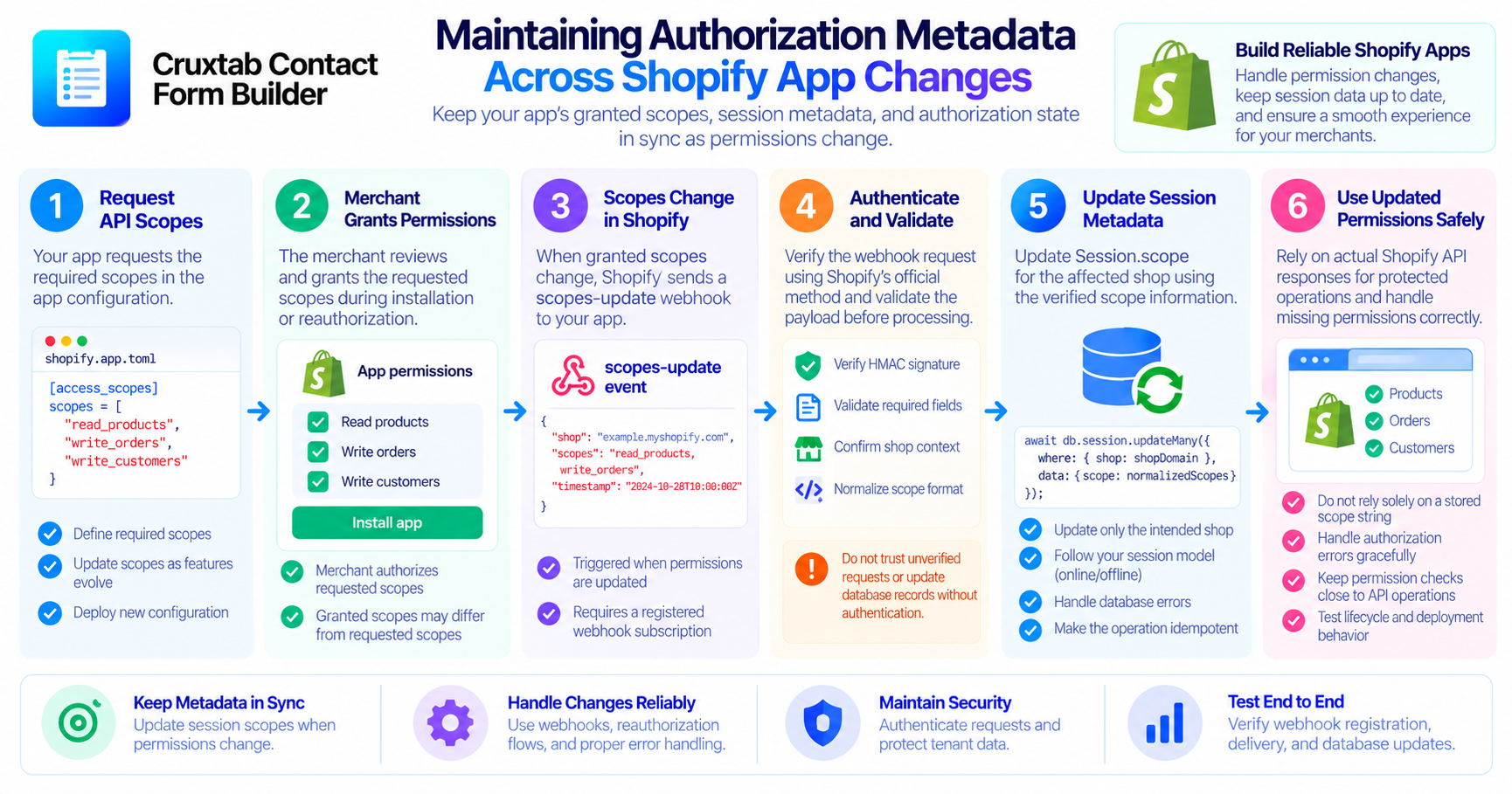
As a Shopify app evolves, it may request different API permissions to support new functionality or changes to existing features.
Managing those permission changes involves more than updating the app's requested scopes. The application also needs to understand the permissions that have actually been granted and maintain its local authorization metadata accordingly.
Requested scopes and granted scopes are different
The scopes an app requests describe the permissions it seeks. The granted scopes describe the permissions available under the current authorization.
Those values should not be treated as interchangeable.
A merchant's authorization state and the app's requested permissions can change over time. The application should use the appropriate Shopify authorization information when determining which permissions are available.
A local Session.scope field is useful metadata, but it should not be treated as an independent source of authorization truth.
Use events to maintain local state
A scopes-update webhook can notify the application when granted scopes change.
The handler can update the stored session scope information so the database reflects the event's authorization metadata.
This is particularly useful when other parts of the application inspect the stored scope list for diagnostics or authorization-state management.
However, webhook processing depends on correct registration and delivery. A handler that is never invoked cannot keep the stored data synchronized.
Consider other authorization paths
A webhook should not be the only thing developers think about when maintaining authorization metadata.
The app should also consider its normal authentication and reauthorization flows, the behavior of its session storage adapter, and any other mechanism that refreshes authorization state.
The right design depends on the application's architecture. The goal is to ensure that local metadata is updated at the appropriate points without treating a stale field as proof that a permission is available.
Keep permission checks close to protected operations
When an operation requires a particular Shopify permission, the application should handle authorization failures correctly rather than relying exclusively on an old scope string stored in the database.
The scope field can support diagnostics and decision-making, but actual API operations must still be prepared for missing permissions or authorization changes.
This distinction helps prevent confusing behavior when a merchant changes access or when the application's stored metadata temporarily falls behind.
Verify lifecycle and deployment behavior
Test scope changes through the relevant authorization workflows and verify that the local session data updates as expected.
Also check the deployed webhook subscription. If the scopes-update topic is not subscribed to in the app's TOML configuration, confirm whether another supported mechanism registers it.
This should be treated as an integration verification task, not merely a code review of the handler.
Conclusion
Maintaining authorization metadata is an ongoing responsibility as a Shopify app changes. Reliable handling requires a clear distinction between requested and granted scopes, consistent session updates, robust authorization behavior, and verified webhook delivery.
For Shopify merchants looking for customizable storefront forms, explore Cruxtab Contact Form Builder.
Comments
Join the discussionNo comments yet. Be the first to comment.