Validating Bundle Limit Rules Before Saving Configuration
Configuration-driven applications give merchants flexibility, but that flexibility also creates validation challenges.
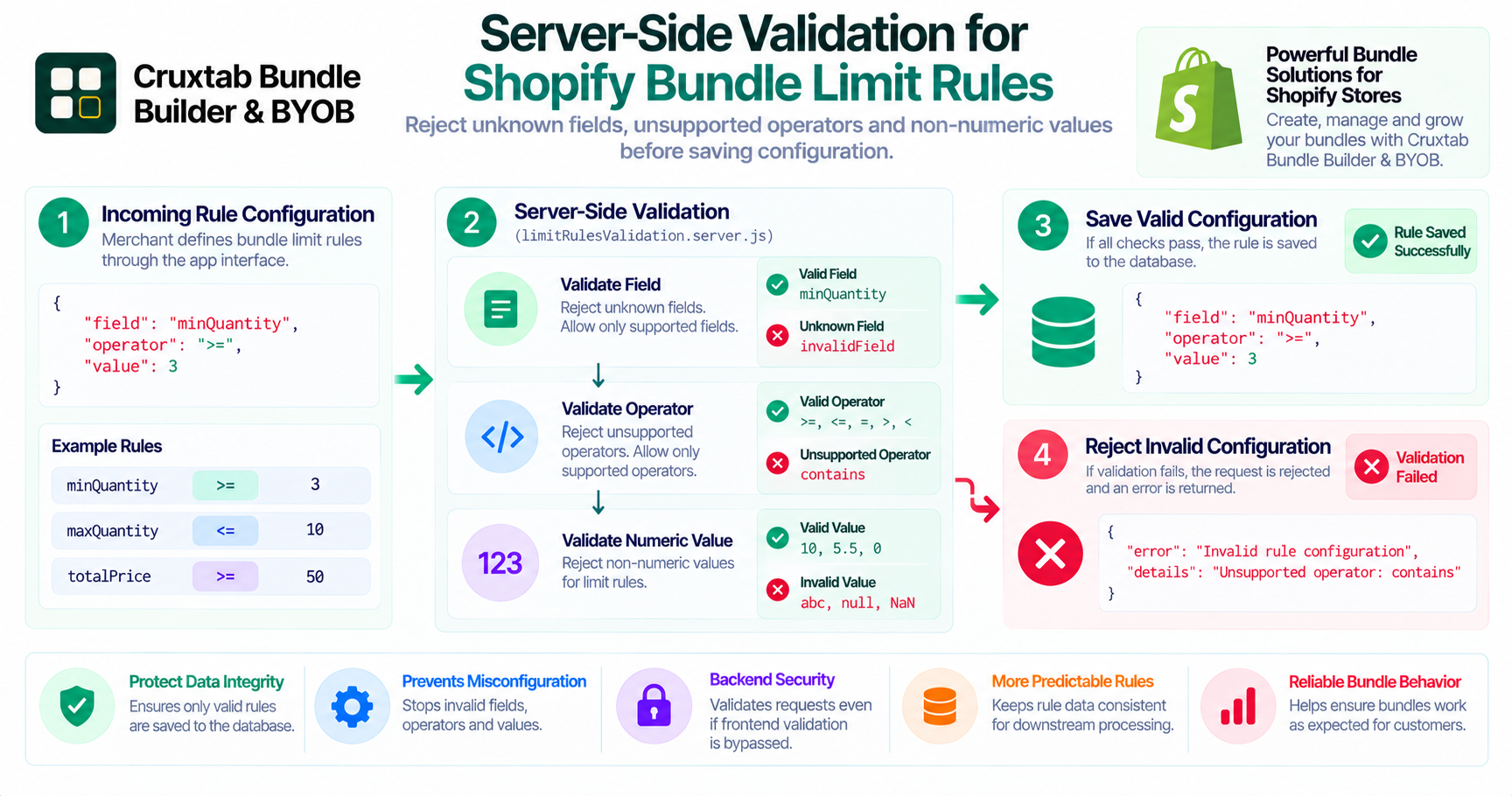
When users define rules through an interface, the backend must ensure that the submitted configuration contains supported fields, valid operators, and values of the expected type.
Without server-side validation, invalid rules can enter the database and cause unexpected behavior later.
Why rule validation matters
A bundle limit rule may contain several pieces of configuration:
- A field identifying what the rule applies to
- An operator defining the comparison
- A value used by the rule
Each part must be checked before the application saves the configuration.
Frontend validation is useful for immediate feedback, but it should not be the only validation layer. Requests can be submitted directly to backend endpoints without using the interface.
The validation implementation
Cruxtab Bundle Builder implements limit rule validation in:
limitRulesValidation.server.js
The validation logic rejects three categories of invalid configuration:
- Unknown fields
- Unsupported operators
- Non-numeric values
This ensures that saved limit rules follow the application's accepted configuration structure.
Rejecting unknown fields
An allowlist of supported fields helps prevent unexpected properties from entering the rule configuration.
This is preferable to accepting arbitrary keys and hoping downstream logic can interpret them.
Checking supported operators
Operators define how a rule compares values.
The backend should accept only operators supported by the application's rule engine.
For example, a comparison engine might support equality or greater-than operations, but the exact accepted set should come from the application's implementation.
Unknown operators should be rejected rather than silently accepted.
Enforcing numeric values
Limit rules that expect numeric values should reject values that are not numeric.
This prevents invalid configuration from reaching calculations or comparisons.
Validation should also consider whether special numeric values, such as non-finite numbers, are acceptable for the application's requirements.
Why server-side validation is essential
A secure configuration flow should validate submitted data at the backend boundary.
This protects the application even when:
- A request is manually constructed
- A browser-side validation rule is bypassed
- An outdated client submits an unsupported field
- A malformed value reaches the endpoint
Conclusion
Configuration validation protects the consistency of rule data and makes downstream processing more predictable.
Cruxtab Bundle Builder validates limit rules on the server, rejecting unknown fields, unsupported operators, and non-numeric values before saving.
Explore Cruxtab Bundle Builder & BYOB.
Comments
Join the discussionNo comments yet. Be the first to comment.