Managing Data Consistency When Building Shopify Admin Features
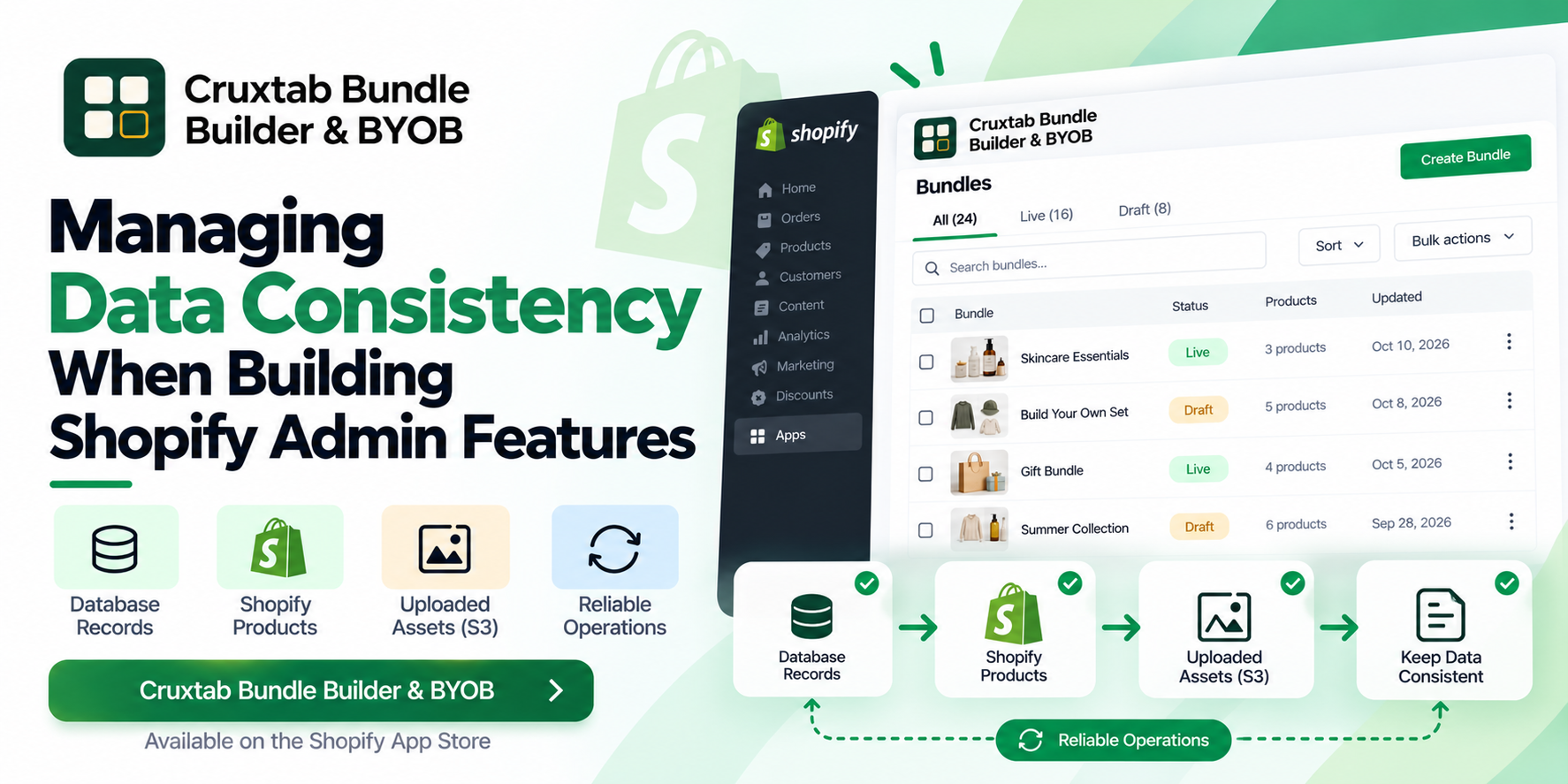
A Shopify application often manages more than the information visible in its admin interface. A single resource may be connected to database records, Shopify products, uploaded images, and other related objects.
This creates an engineering challenge: what happens when a resource is duplicated, updated, or deleted?
If these operations are not designed carefully, an application can end up with orphaned files, inconsistent references, or records that no longer represent the intended storefront configuration.
In this article, we'll explore practical considerations for maintaining data consistency when building administrative features for Shopify apps.
1. Understand the Full Resource Lifecycle
Before implementing an administrative action, identify the resources involved.
For a product bundle, the lifecycle might include:
Creating a bundle configuration.
Creating or updating associated Shopify products.
Changing the bundle's status.
Duplicating an existing configuration.
Deleting a bundle and cleaning up related resources.
Each operation can affect multiple systems. For example, deleting a database record does not automatically remove an uploaded image from an external storage service.
Mapping these dependencies before writing the implementation helps developers identify potential failure points.
2. Keep Database Relationships Explicit
Related records should have clearly defined ownership and lifecycle rules.
Suppose a bundle contains several child records. If the parent bundle is deleted, the application needs a deliberate policy for what happens to those children.
Depending on the data model, this might involve database cascade deletion, explicit cleanup operations, or a combination of both.
The important distinction is between relational data and external resources. A database transaction can help maintain consistency within a database, but it cannot automatically guarantee that a separate Shopify API request or object-storage deletion succeeds.
Developers should account for these boundaries instead of assuming every operation is atomic.
3. Design Duplication as a Separate Operation
Duplicating a resource sounds straightforward, but copying every property from the original can create unexpected behavior.
A reliable duplication workflow should define which values are reusable and which must be generated again.
For example:
A new resource needs its own unique identifier.
Child records may need to be recreated with new identifiers.
Mutable child records should not accidentally be shared with the original.
External product references need an explicit retention or replacement policy.
Uploaded assets need a clear ownership and reuse strategy.
These decisions should be reflected in the implementation and tested independently.
One useful test is to modify or delete the duplicate and verify that the original resource remains unaffected.
4. Treat External API Calls as Failure Points
Shopify applications often coordinate local database changes with operations performed through Shopify's APIs.
External requests can fail because of temporary network problems, rate limits, permission issues, or validation errors.
A robust implementation should decide what happens when only part of a workflow succeeds.
Depending on the operation, useful strategies may include:
Validating inputs before making external changes.
Recording the state of each operation.
Retrying transient failures where safe.
Designing idempotent operations so retries don't create unintended duplicates.
Providing a recovery path for incomplete workflows.
The correct strategy depends on the operation. Retrying a read request is different from retrying a product-creation request that may already have succeeded.
For destructive operations, careful sequencing and explicit failure handling are especially important.
5. Clean Up Uploaded Assets Deliberately
Images and other files stored outside the main database need their own lifecycle management.
For example, deleting a bundle might require removing an image from Amazon S3 after its associated database records have been handled.
Developers should consider what happens if the database operation succeeds but the file deletion fails.
One option is to track pending cleanup tasks and retry them later. Another is to use a background job for operations that do not need to finish during the user's request.
The best choice depends on the application's architecture, but cleanup should be observable and recoverable rather than silently abandoned.
It is also important to establish whether an asset is shared. A file should not be deleted if another resource still depends on it.
6. Make Administrative Actions Safe to Repeat
Users may click twice, requests may time out, and clients may retry after an uncertain response.
These situations make idempotency an important design consideration.
An operation is idempotent when repeating it produces the same intended result rather than repeating its effects.
For example, setting a bundle's status to draft can often be implemented as a state assignment. Creating a new bundle, however, requires more care because repeating the request might create multiple resources.
Developers can use stable operation identifiers, uniqueness constraints, state checks, or other appropriate safeguards to prevent unintended repeated effects.
Not every action can be made idempotent in the same way, so the behavior should be considered individually.
7. Apply These Principles to Bundle Management
In Cruxtab Bundle Builder & BYOB, the bundle management workflow includes duplication, deletion, Shopify product operations, and cleanup of associated child records and S3 images.
These operations illustrate why resource lifecycle design matters in a Shopify application.
A bundles list may look like a simple administrative table, but its actions can affect multiple connected resources. The implementation needs to preserve the intended relationships while handling external dependencies.
The app is available on the Shopify App Store.
For developers building similar applications, the broader lesson is to define lifecycle behavior before implementing the interface. Knowing what should happen to related records, external resources, and failed operations makes the resulting system easier to reason about and maintain.
Conclusion
Data consistency is not limited to database schemas. It also involves external APIs, uploaded files, resource duplication, retries, and cleanup.
When building Shopify admin features, explicitly define resource ownership, handle partial failures, make repeated operations safe where possible, and ensure that cleanup can be verified.
These practices help prevent subtle inconsistencies and make applications more reliable as their data and feature sets grow.
The goal is to ensure that every administrative action has predictable consequences, even when several systems are involved.
Comments
Join the discussionNo comments yet. Be the first to comment.