Making Product Bundles Dynamic with Conditional Rules
A product bundle does not always need to behave the same way for every customer.
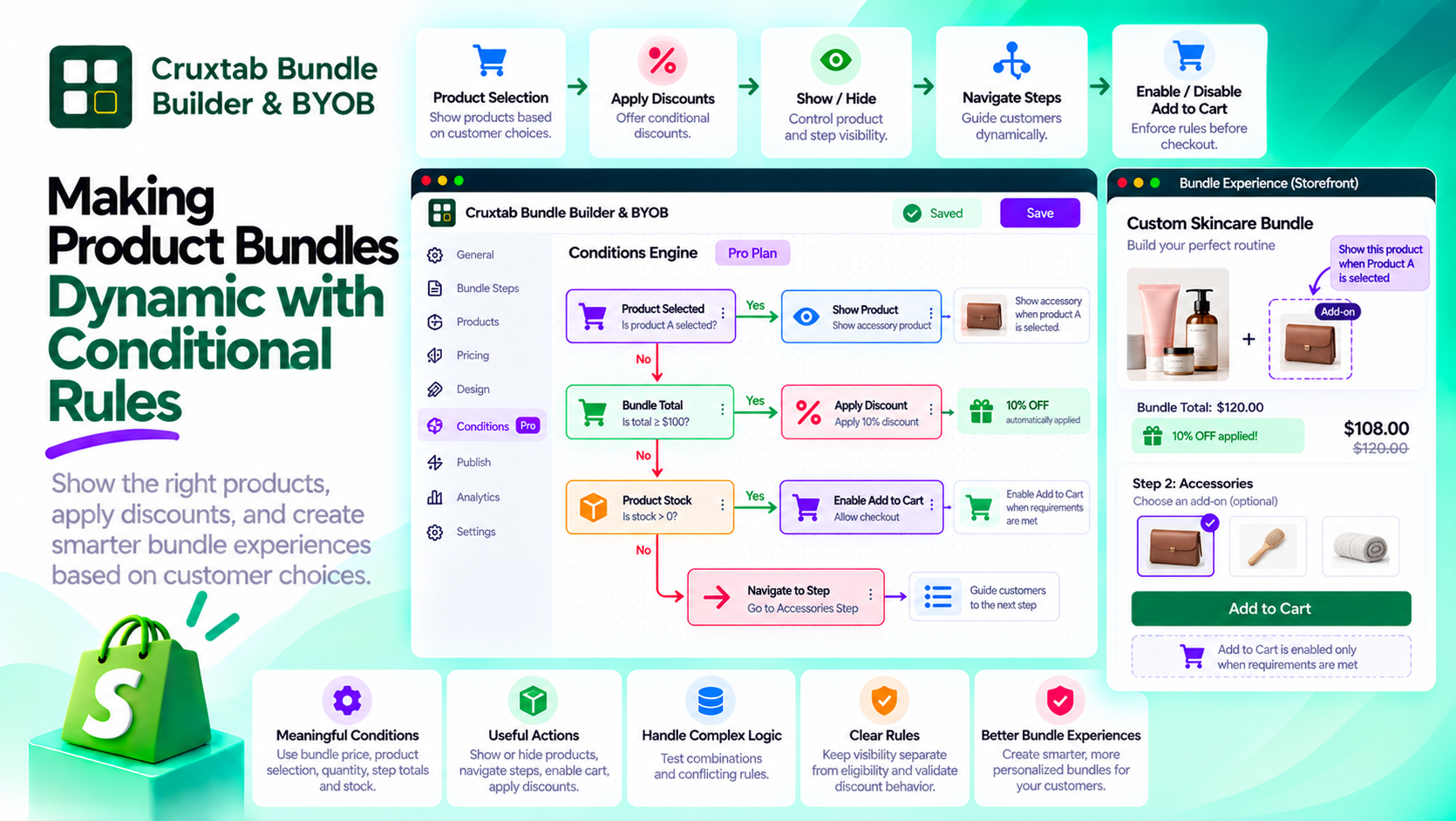
A merchant might want to reveal an accessory when a particular product is selected, apply a discount after the customer reaches a spending threshold, or prevent checkout progression until a required condition is satisfied.
Conditional rules make these experiences possible without requiring a separate bundle implementation for every scenario.
Start with meaningful conditions
A useful conditions engine evaluates information that already exists in the bundle configuration or current selection.
Examples include:
- The current bundle price
- The total number of selected products
- Whether a particular product is included
- The quantity of a particular product
- The price or product total of an individual step
- The stock condition of a product
Each check should have a clear definition so that merchants understand what the rule evaluates.
For example, "product total" should specify whether it counts all selected items or only eligible items. Likewise, a stock condition should define how unavailable or unknown inventory is handled.
Connect conditions to useful actions
Checks become valuable when they control a meaningful part of the customer experience.
Consider a bundle that offers an optional accessory.
A product-presence check could determine whether the customer has selected a particular item. An associated action could then reveal an additional product or step.
Other actions might navigate to a different step, disable the add-to-cart button, or apply a configured discount.
The application should define exactly when each action takes effect and whether it remains active when the underlying condition changes.
Keep visibility separate from eligibility
Hiding a product in the interface is not the same as making that product ineligible for purchase.
A hidden item may still exist in the customer's previous selection state, depending on how the storefront handles changes.
For this reason, the application needs explicit rules for what happens when a product or step becomes hidden.
Similarly, disabling the add-to-cart button should improve the user experience, but server-side and cart-level validation must still enforce the actual purchasing requirements.
Define discount behavior carefully
Conditional discounts need clear eligibility rules.
For example, a discount might depend on the bundle's total price or the number of qualifying products selected.
The application should specify how that discount interacts with existing bundle pricing, minimum purchase requirements, and other promotions.
It should also ensure that the price presented to customers is consistent with the price used in the actual purchasing flow.
Test combinations, not just individual rules
The complexity of a conditions engine often comes from interactions between rules.
A product may become hidden while a step still requires it. Two conditions may trigger competing navigation actions. A discount condition may depend on a product whose eligibility changes.
Testing each node in isolation is not enough.
Useful tests should cover combinations of checks and actions, including cases where the condition changes after the customer makes a selection.
How Cruxtab supports dynamic bundles
Cruxtab Bundle Builder & BYOB includes a Pro Conditions Engine with checks for bundle price, product totals, product presence, step-level conditions, and product stock.
Its actions include navigating between steps, showing or hiding products and steps, enabling or disabling the add-to-cart button, and applying discounts.
Explore the app: https://apps.shopify.com/cruxtab-bundle-builder
Conclusion
Conditional rules allow a bundle to respond to a customer's choices instead of remaining a static product configuration.
Define checks precisely, keep visibility separate from purchasing eligibility, validate discounts, and test interactions between rules. These practices help make dynamic bundle experiences more predictable.
Comments
Join the discussionNo comments yet. Be the first to comment.