Error Handling and Observability for External API Integrations
External API integrations make applications more useful, but they also introduce dependencies outside the application's direct control.
An external service may be unavailable, reject a request, return unexpected data, or change its API behavior.
A reliable integration needs a plan for handling these conditions.
Why external integrations fail
An integration can fail for many reasons:
- Invalid credentials.
- Missing permissions.
- Incorrect request payloads.
- Rate limits.
- Network problems.
- Provider-side service interruptions.
- API version changes.
These failures can affect different parts of the application depending on when and how the integration is executed.
The integration landscape in Cruxtab
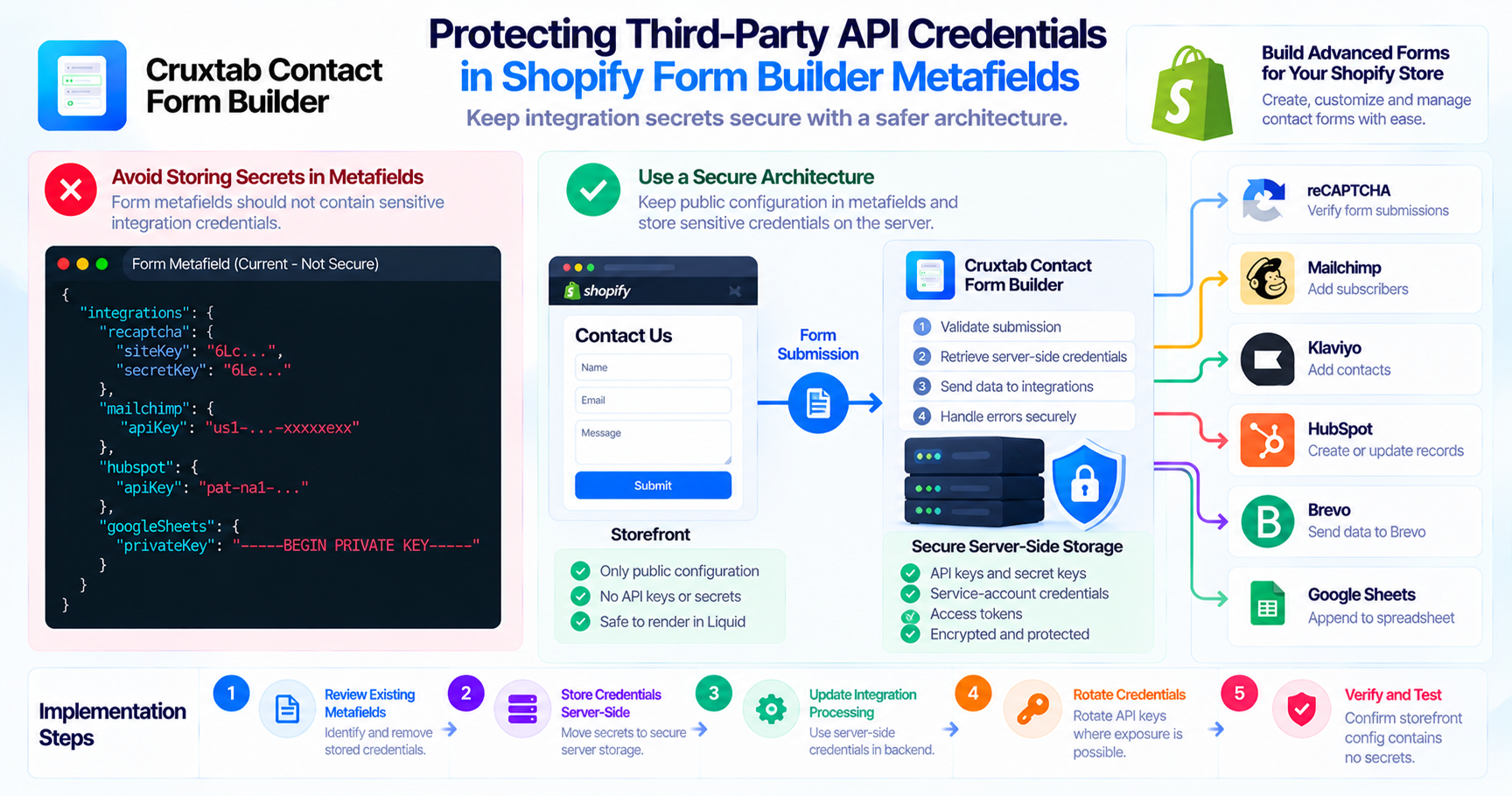
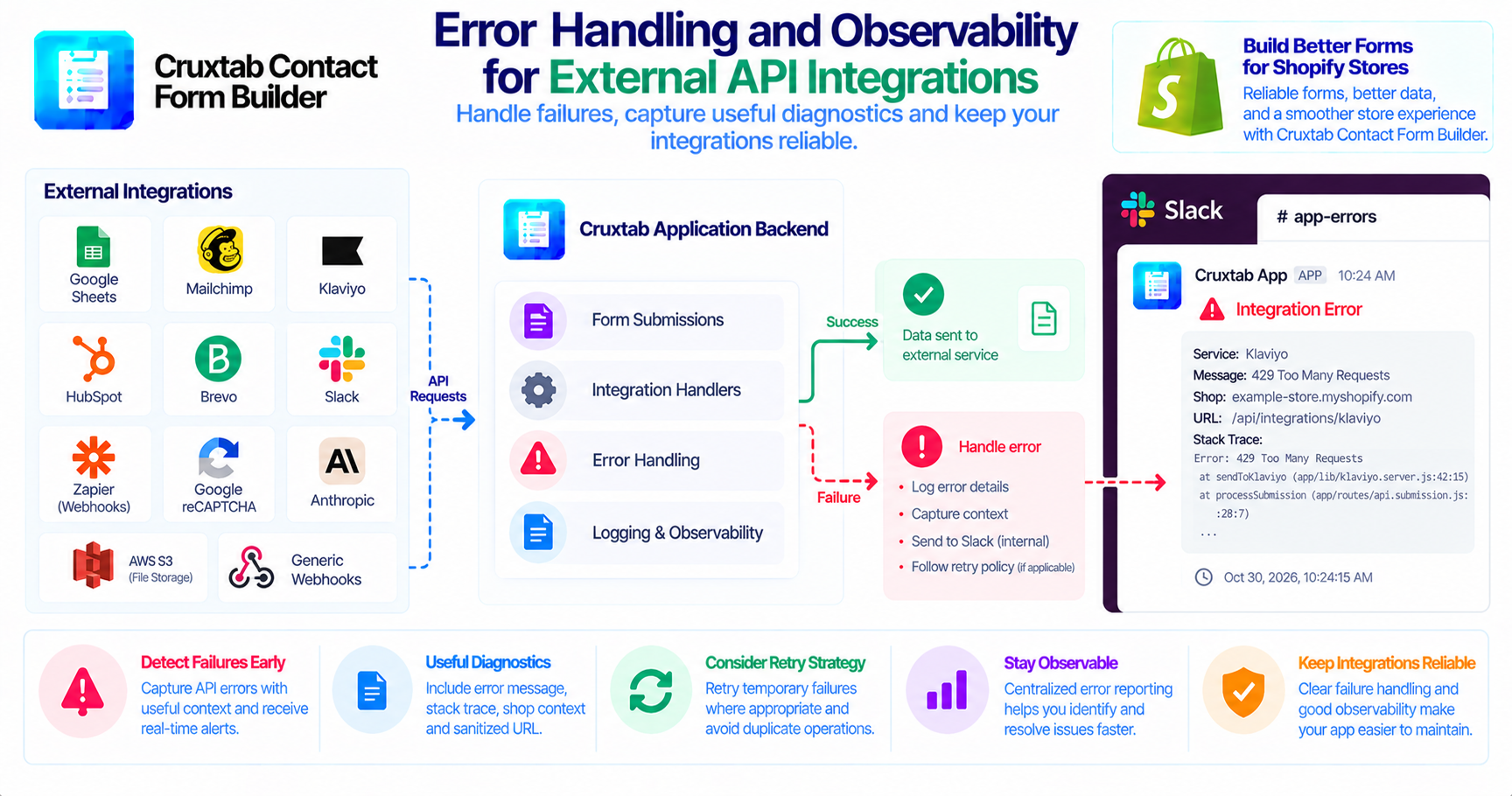
Cruxtab Contact Form Builder connects to multiple external services, including:
- Google Sheets.
- Mailchimp.
- Klaviyo.
- HubSpot.
- Brevo.
- Slack.
- Zapier and generic webhooks.
- Google reCAPTCHA.
- Anthropic.
- AWS S3.
These services have different request formats and response behaviors. Error handling should therefore account for the requirements of each provider.
Centralized error reporting
Cruxtab also includes internal Slack error reporting through app/lib/slack.server.js.
Unhandled React Router errors are reported through the server entry point app/entry.server.jsx, and the shared utility supports many caught errors.
The integration uses:
SLACK_ERROR_WEBHOOK_URL
Notifications can be muted using:
SLACK_ERROR_NOTIFICATIONS_ENABLED=false
This provides a way for developers to receive internal error notifications separately from merchant-configured integrations.
Preserve useful diagnostic context
Useful error reports can include:
- Error message.
- Stack trace.
- Shop context.
- Sanitized URL.
Sensitive values should be removed before sending error details to an external notification service.
Also distinguish an integration failure from a form submission failure. Whether a submission should succeed when an optional integration fails is a product decision that should be clearly defined and tested.
Think carefully about retries
Retries can help recover from temporary failures, but they can also create duplicate operations.
For example, retrying a contact-creation request or webhook delivery may have different consequences depending on the destination API.
Before adding automatic retries, understand whether the operation is idempotent and whether the provider supports an idempotency mechanism.
Conclusion
External integrations require more than successful API requests. Useful diagnostics, clear failure policies, and careful retry design help make connected applications easier to maintain.
Explore Cruxtab Contact Form Builder to learn more about its integration ecosystem.
SEO title: Error Handling for External API Integrations
Meta description: Learn how to manage external API failures, improve observability, and design reliable error handling for integrations in a Shopify application.
Tags: API Integration, Error Handling, Observability, Node.js, Shopify Apps
Cover image idea: A central application backend connected to external APIs, with failed requests flowing into an error monitoring channel.
Comments
Join the discussionNo comments yet. Be the first to comment.