Designing Secure Shopify Webhook Handlers
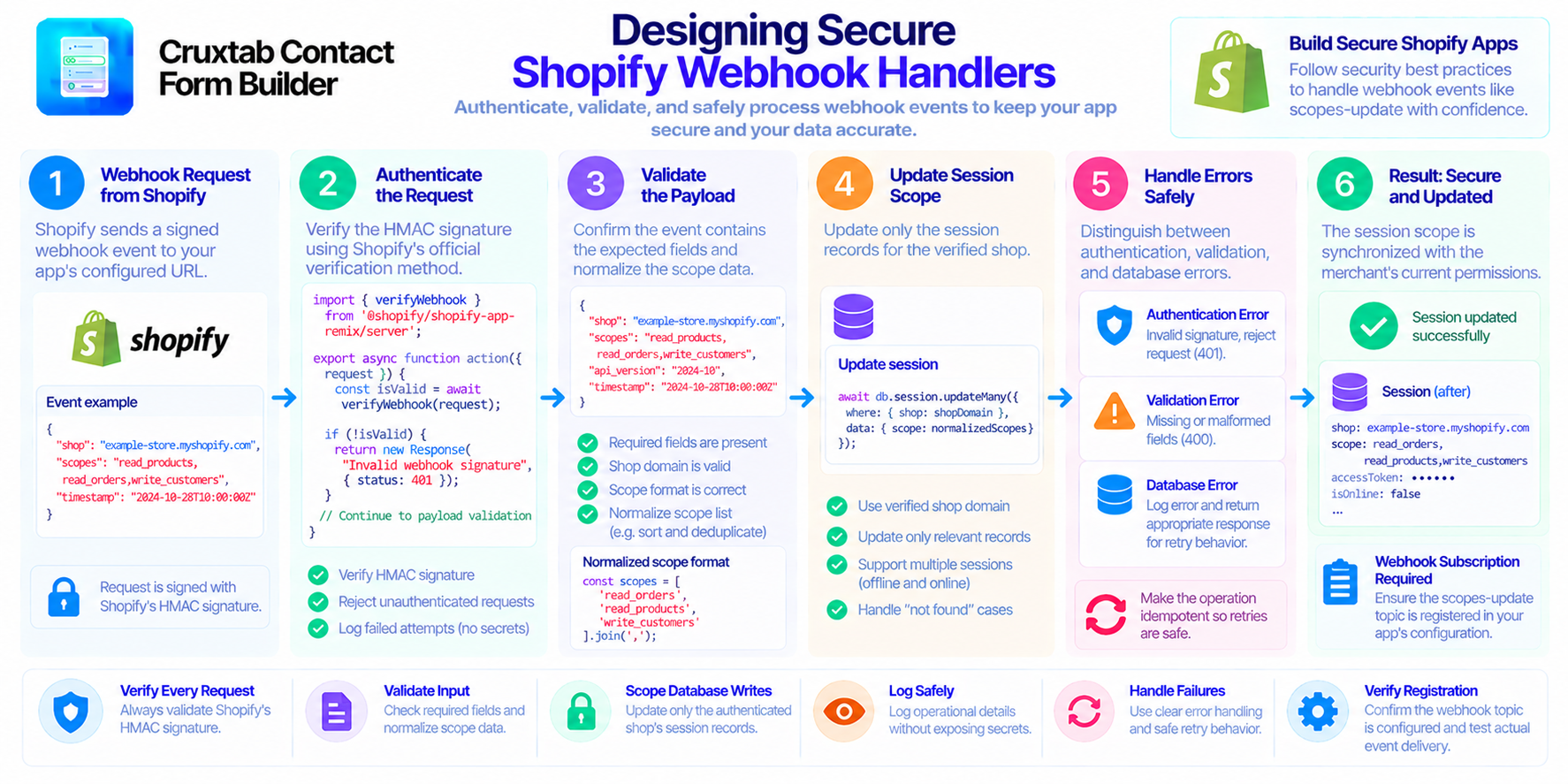
Webhooks allow Shopify to notify an application when important events occur. Because these requests can trigger database updates or other application behavior, webhook handlers need a deliberate security model.
A scopes-update webhook is a useful example: it can modify stored authorization metadata, so the application must establish that the event is authentic before processing it.
Authenticate before processing
Use Shopify's supported webhook verification mechanism for the framework and API version used by the app.
Verification should happen before the application trusts the event payload or performs database writes.
Do not rely only on a shop domain, a user-agent header, or a JSON field to establish authenticity.
Validate the event payload
After authentication, validate that the payload contains the fields the handler expects.
For a scopes-update event, the handler should confirm that the shop context and scope information are present in the expected format.
The handler should also normalize the scope list to the representation used by the application's session storage.
This helps avoid inconsistent data when the incoming payload is valid but differs from the application's internal representation.
Restrict database changes
The update should affect only the session records associated with the verified shop.
Do not use an untrusted shop identifier to construct a broad database update. Use the authenticated event context and the application's established tenant-identification rules.
If no matching session is found, define whether the handler should treat that as an expected condition, record a warning, or initiate another recovery step.
Avoid exposing credentials in logs
Session records can contain sensitive information. When diagnosing scope synchronization, log only the operational details needed to understand the failure.
Avoid writing access tokens, full session objects, or other secrets to application logs.
A useful log entry might identify the event type, shop context, result category, and correlation identifier without revealing credentials.
Handle failures explicitly
A database error should not be mistaken for a successful scope update.
The handler should distinguish authentication failures, malformed payloads, and storage failures. Use the webhook framework's documented response and retry behavior rather than assuming that every failure will automatically be retried.
If retries are supported and appropriate, ensure the operation is safe to repeat.
Confirm the subscription exists
Authentication and validation protect a handler that receives a request, but they do not establish that Shopify is subscribed to the event.
Verify the effective registration of the scopes-update topic in the deployed app. If the route exists but the topic is not registered, the handler may never execute for actual scope changes.
Conclusion
Secure webhook processing requires authentication, payload validation, narrowly scoped database updates, careful logging, and explicit error handling. Correct subscription configuration is also essential because a secure handler cannot process an event it never receives.
For Shopify storefront form workflows, visit Cruxtab Contact Form Builder.
Comments
Join the discussionNo comments yet. Be the first to comment.