Building Idempotent Shopify Webhook Processing with Database Constraints
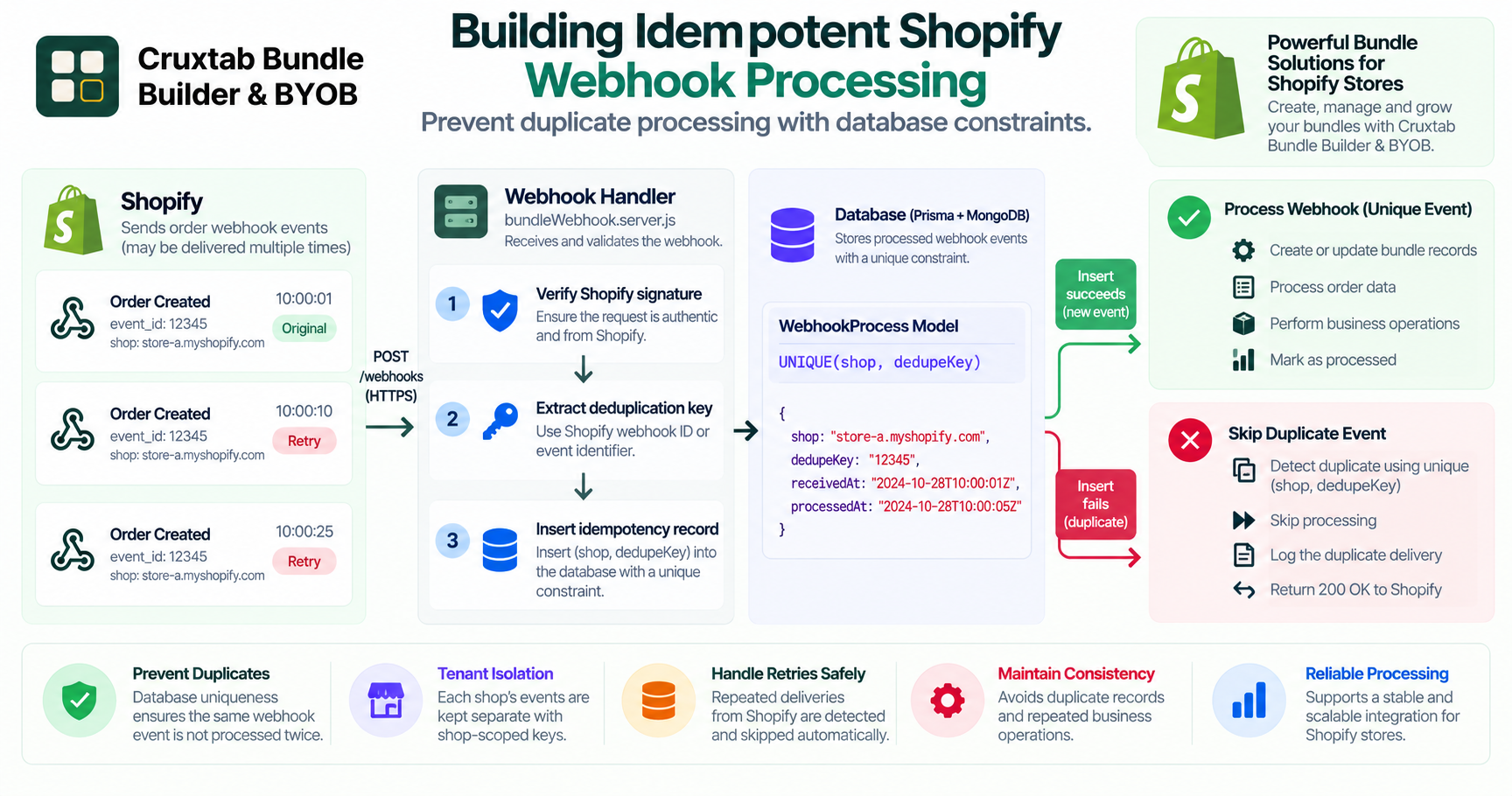
Shopify webhooks are designed to notify applications when events occur. However, webhook deliveries can be repeated. An application that processes every delivery as a new event risks performing the same operation multiple times.
For a bundle-building application, duplicate processing can lead to inconsistent records or repeated business operations. Webhook idempotency helps prevent this.
Why webhook idempotency matters
Webhook delivery should not be treated as a guarantee that an event will arrive exactly once. Applications need to account for repeated deliveries and make processing safe to retry.
A useful approach is to maintain a record of processed webhook events and enforce uniqueness at the database level.
Using a unique shop and deduplication key
Cruxtab Bundle Builder implements webhook idempotency in bundleWebhook.server.js.
Before processing an order webhook, the application attempts to insert a record containing a unique combination of:
- Shop
- Deduplication key
The unique combination ensures that the same event cannot be registered repeatedly for the same shop.
Conceptually, the database constraint represents:
UNIQUE(shop, dedupeKey)
If the insert succeeds, the application can continue processing the webhook.
If the insert encounters an existing record, the delivery is treated as a duplicate and skipped.
Why the shop identifier matters
A Shopify application can serve multiple stores. The same deduplication value should not automatically be treated as a duplicate across unrelated shops.
Scoping the uniqueness constraint to the shop keeps event processing isolated between tenants.
Database-level uniqueness is important
Checking for an existing record in application code alone can introduce race conditions.
For example, two webhook requests could arrive at nearly the same time. Both might check for an existing record before either inserts it.
A database uniqueness constraint provides a stronger guarantee because the database coordinates competing inserts.
Additional considerations
A production webhook system should also consider:
- How long idempotency records are retained
- What happens if processing fails after the idempotency record is inserted
- Whether failed events can be retried safely
- How concurrent webhook deliveries are handled
- How duplicate deliveries are logged and monitored
The exact recovery strategy depends on the relationship between the idempotency record and the business operation.
Conclusion
Idempotency is a fundamental part of reliable webhook processing. By inserting a unique (shop, dedupeKey) record before processing an order webhook, Cruxtab Bundle Builder can identify duplicate deliveries and avoid processing them as new events.
Explore Cruxtab Bundle Builder & BYOB to learn more about bundle management for Shopify stores.
Comments
Join the discussionNo comments yet. Be the first to comment.